
guitar string gauge guide
Guitar String Gauge Guide: A Comprehensive Overview
Navigating the world of guitar strings requires understanding gauge, a crucial factor impacting playability, tone, and tuning stability. This guide,
informed by experts like Ryan “Fluff” Bruce, simplifies the process of selecting the ideal string set for your instrument and style.
Ernie Ball’s resources, including detailed articles and videos, offer invaluable insights into scale length considerations (Fender vs. Gibson) and how they relate to optimal string gauge choices.
Understanding String Gauge Basics

String gauge refers to the thickness of the strings, directly influencing tension, feel, and tonal characteristics. It’s a fundamental aspect of guitar setup and personal preference, impacting everything from bending ease to overall sound projection;
Understanding this concept is the first step towards optimizing your playing experience. Resources from Ernie Ball emphasize that selecting the right gauge isn’t a one-size-fits-all solution; it depends on factors like scale length, tuning, and individual playing style. Choosing wisely enhances comfort and unlocks your guitar’s full potential.
What Does String Gauge Actually Mean?
String gauge isn’t about length, but the diameter of the string core wire, measured in thousandths of an inch. A higher gauge number indicates a thicker string, resulting in greater tension when tuned to standard pitch.
This thickness profoundly affects playability and tone. Ernie Ball’s guides clarify that thicker strings offer more volume and sustain, while thinner strings are easier to bend. Understanding this relationship empowers guitarists to tailor their instrument’s feel and sound to their specific needs and preferences.
How String Gauge is Measured
String gauge is quantified in thousandths of an inch, representing the diameter of the plain steel strings and the core wire of the wound strings. A set is typically described by the gauge of the high E string and the low E string – for example, .010 ⸺ .046.
This notation indicates a .010 inch high E string and a .046 inch low E string. Ernie Ball’s resources emphasize that these measurements are crucial for understanding the overall tension and feel of a string set, influencing playability and tonal characteristics.
Common String Gauge Sets for Electric Guitar
Electric guitarists have a wide array of string gauge options, each offering a distinct playing experience. Popular choices include Extra Light (.008 ― .038), known for ease of bending, Light (.009 ⸺ .042), a versatile all-rounder, and Regular/Medium (.010 ⸺ .046), favored for balanced tone and sustain.
Heavier gauges (.011 ― .048/052) provide increased tension, ideal for lower tunings and aggressive playing styles. Ernie Ball’s guide highlights that selecting the right gauge depends on individual preferences, scale length, and musical genre.
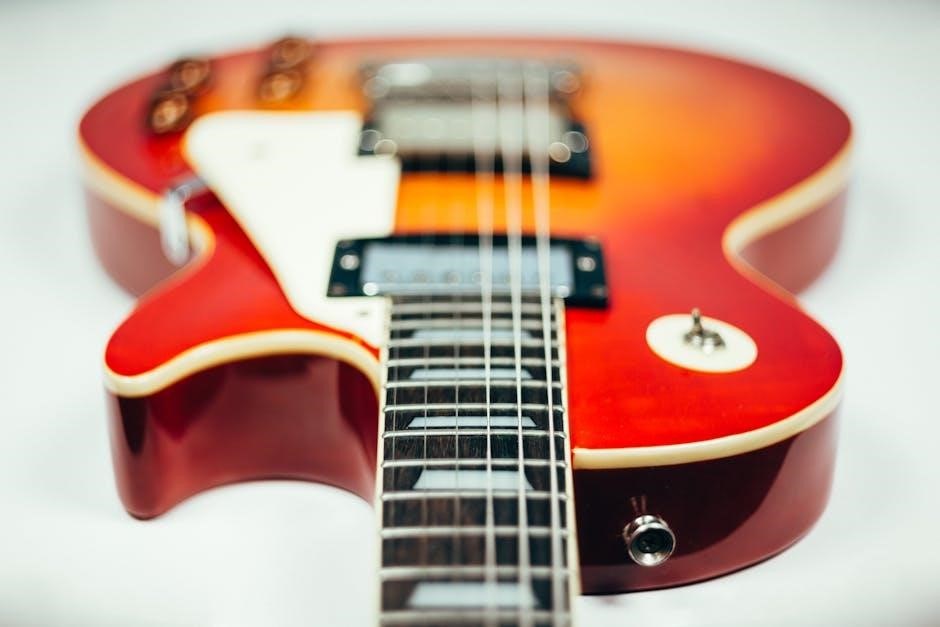
Extra Light (.008 ⸺ .038)
Extra Light strings (.008 ⸺ .038) are the thinnest gauge, offering the easiest playability and bending capabilities. They require the least amount of finger strength, making them excellent for beginners or players who prioritize effortless string manipulation.
However, this lightness comes with trade-offs: reduced volume, thinner tone, and increased susceptibility to breakage. Ernie Ball’s resources suggest these are best suited for players seeking maximum comfort and expressive bending, particularly in higher registers.
Light (.009 ⸺ .042)
Light gauge strings (.009 ⸺ .042) represent a popular balance between playability and tonal fullness. They are slightly thicker than Extra Light sets, providing increased volume and sustain without significantly sacrificing bending ease.
These strings are a versatile choice for various genres and playing styles, often recommended for beginners progressing beyond Extra Light gauges. Ernie Ball’s guidance highlights their suitability for players seeking a comfortable feel with a more robust sound, offering a solid foundation for developing technique.
Regular/Medium (.010 ― .046)
Regular or Medium gauge strings (.010 ⸺ .046) offer a fuller, more powerful tone compared to lighter gauges. They provide increased sustain and projection, making them a favorite among rhythm guitarists and players who prioritize a robust sound.

While requiring slightly more finger strength, these strings maintain good playability. According to resources like Ernie Ball’s guide, they are well-suited for standard tuning and offer enhanced stability, particularly beneficial for more aggressive playing styles and complex chord voicings.
Heavy (.011 ⸺ .048/052)
Heavy gauge strings (.011 ― .048/052) deliver the thickest, most powerful tone, favored by players in genres like metal and hard rock. They excel in lower tunings, providing the necessary tension to maintain clarity and prevent floppiness.
However, these strings demand significant finger strength and can be more challenging to bend. As highlighted by resources like Ernie Ball’s string gauge guide, they are ideal for those prioritizing a massive sound and stability in drop tunings, but may require adjustments to guitar setup.

String Gauge and Scale Length
The relationship between string gauge and scale length is fundamental to guitar setup and playability. Longer scale lengths, like those found on Fender guitars (25.5″), generally require heavier gauges to achieve similar tension to shorter scale lengths.
Conversely, Gibson guitars (24.75″) often pair well with lighter gauges. As detailed in resources from Ernie Ball, considering scale length ensures optimal intonation, comfortable action, and prevents issues like neck bowing or excessive string tension. Choosing the right gauge for your scale length is crucial.
Fender Scale (25.5″) Considerations
Fender guitars, boasting a 25.5″ scale length, benefit from slightly heavier string gauges to maintain comfortable tension and optimal tone. Ernie Ball’s guidance suggests that .010-.046 sets are a popular starting point, providing a balance between playability and fullness.
However, players experimenting with lower tunings may prefer .011 or even .012 gauge sets. The longer scale requires more tension to reach standard pitch, making heavier gauges necessary for a responsive feel and preventing a “floppy” sound.
Gibson Scale (24.75″) Considerations
Gibson guitars, with their shorter 24.75″ scale length, generally perform well with lighter string gauges compared to Fenders. According to Ernie Ball’s resources, a .009-.042 set is a common choice, offering easier bending and a comfortable playing experience.
The reduced scale length means less tension is needed to reach pitch, so heavier gauges can feel overly tight. Players venturing into lower tunings might opt for .010s, but careful setup adjustments are crucial to avoid intonation issues.
Impact of String Gauge on Playability
String gauge significantly influences how a guitar feels and responds to a player’s touch. Ernie Ball’s guide, featuring insights from Ryan “Fluff” Bruce, highlights this connection. Lighter gauges (.008 ⸺ .009) facilitate easier bending and vibrato, ideal for lead playing, but can feel less substantial.
Heavier gauges (.010+) offer more control and a fuller tone, but require more finger strength, potentially leading to fatigue. Comfort is key; choosing a gauge that suits your hand strength and playing style is paramount.
Bending and Vibrato
Lighter gauge strings, typically in the .008 to .009 range, dramatically reduce the tension required for bending notes. This makes achieving expressive bends and vibrato significantly easier, particularly for players with less hand strength or those new to the technique.

As highlighted by Ernie Ball’s resources and “Fluff” Bruce’s guidance, the reduced tension allows for wider, smoother bends with less effort. However, this ease comes with a trade-off – potentially less tonal thickness and sustain compared to heavier gauges.
Finger Fatigue and Comfort
Heavier gauge strings demand more finger strength to fret notes and perform bends, potentially leading to increased finger fatigue during extended playing sessions. This is a key consideration for beginners or players prone to hand discomfort.
Conversely, lighter gauge strings require less pressure, enhancing comfort and allowing for longer practice times. As Ernie Ball’s guides suggest, finding the right balance between playability and tonal preference is crucial, and comfort plays a significant role in that decision.
String Gauge and Tuning
String gauge significantly impacts tuning stability, particularly when venturing beyond standard E tuning. Thinner strings have more flexibility, making them prone to going out of tune, especially with aggressive playing or extreme pitch changes.
Heavier gauges provide increased tension, maintaining stability in lower tunings like Drop D or Drop C. As highlighted by resources like Ernie Ball’s guides, selecting a heavier gauge is often necessary to compensate for reduced tension when downtuning, ensuring consistent pitch and reliable performance.

Standard Tuning (E Standard)

For standard E tuning (E A D G B e), a wide range of string gauges can be effectively utilized, offering diverse playing experiences. Many guitarists comfortably employ light (.009 ― .042) or regular (.010 ― .046) sets, balancing playability with sufficient tonal fullness.
Ernie Ball’s resources suggest that the choice often depends on personal preference and guitar scale length. Lighter gauges are easier to bend, while heavier gauges provide a bolder sound and increased sustain, both viable options within the standard tuning framework.
Drop Tunings (Drop D, Drop C, etc.)
When venturing into drop tunings like Drop D or Drop C, increasing string gauge becomes crucial to maintain adequate tension and prevent a floppy feel. Lower tunings necessitate heavier strings to counteract the reduced pull, ensuring clear intonation and comfortable playability.
Experts recommend moving up at least one gauge set, and potentially two, when significantly dropping the tuning. This prevents excessive string slack and preserves the instrument’s responsiveness, allowing for dynamic performance even in lower registers.
String Gauge and Guitar Setup
Changing string gauge significantly impacts your guitar’s setup, requiring adjustments for optimal playability and intonation. Heavier strings increase tension, potentially necessitating neck relief adjustments to counteract increased pull and prevent bowing.
Intonation adjustments are also vital; heavier strings require lengthening the saddle position to ensure accurate pitch across the fretboard. A properly set-up guitar, tailored to the chosen string gauge, delivers the best playing experience and tonal clarity.
Neck Relief Adjustments
Neck relief, the slight curvature of the guitar neck, must be adjusted when changing string gauges. Heavier gauge strings exert greater tension, often requiring a loosening of the truss rod to increase relief and prevent back-bowing.
Conversely, lighter strings demand tightening the truss rod to reduce relief. Careful observation of the gap between the strings and the 7th-9th frets, combined with gradual adjustments, ensures optimal neck relief for comfortable playing and accurate intonation.
Intonation Adjustments
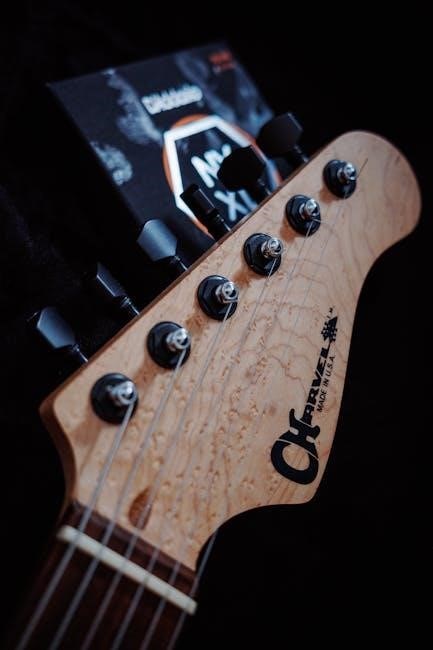
Changing string gauges invariably affects intonation – the accuracy of pitch across the fretboard. Heavier strings typically require lengthening the strings at the saddle to sharpen the pitch at the 12th fret, while lighter strings need shortening to flatten it.
Precise intonation ensures chords sound in tune throughout the neck. Use a tuner to compare the open string pitch to the pitch at the 12th fret, adjusting the saddle position until they match perfectly for each string.
String Gauge for Different Playing Styles
Your playing style significantly influences the ideal string gauge. Lead guitarists often prefer lighter gauges (.009 ― .010) for easier bending and faster runs, prioritizing expressive vibrato and fluid soloing. Conversely, rhythm guitarists frequently opt for heavier gauges (.010 ⸺ .011) to achieve a fuller, more robust tone with enhanced sustain for powerful chord work.
Ultimately, the best gauge complements your technique and desired sonic characteristics.
Lead Guitarists
Lead guitarists commonly gravitate towards lighter string gauges, typically in the .009 to .010 range. This preference stems from the reduced tension, facilitating effortless string bending – a cornerstone of expressive lead playing. Lighter strings also enable faster execution of intricate solos and vibrato techniques, crucial for conveying emotion and musicality.
While sacrificing some tonal fullness, the enhanced playability empowers lead players to explore a wider range of melodic possibilities.
Rhythm Guitarists
Rhythm guitarists often prefer heavier string gauges, generally ranging from .010 to .011 or even heavier. This choice prioritizes a fuller, more resonant tone, essential for providing a solid harmonic foundation. Heavier strings deliver increased sustain and a robust low-end response, crucial for powerful chord voicings and driving rhythms.
While bending may require more effort, the enhanced tonal characteristics and stability are paramount for rhythm playing, ensuring a powerful and authoritative sound.
String Gauge and Tone
String gauge significantly influences a guitar’s tonal characteristics. Lighter gauge strings (.008 ⸺ .009) generally produce a brighter, more articulate tone with less sustain, ideal for lead work. Conversely, heavier gauges (.011 and up) yield a warmer, fuller sound with increased sustain, favored by rhythm players.
Heavier strings also enhance low-end frequencies, contributing to a richer overall sonic texture. The choice depends on the desired tonal palette and playing style, impacting clarity and resonance.
Brightness and Clarity
Lighter gauge strings excel in delivering exceptional brightness and clarity. Their reduced mass allows for quicker string vibration, emphasizing higher frequencies and resulting in a crisp, articulate tone. This characteristic makes them particularly well-suited for genres demanding precise note definition, such as funk or clean jazz.
The thinner profile also minimizes unwanted overtones, enhancing the fundamental note’s presence. However, this brightness can sometimes lack the warmth and fullness of heavier gauges, requiring careful equalization.
Warmth and Sustain
Heavier gauge strings contribute significantly to a warmer, fuller tonal character and extended sustain. Their increased mass transfers more energy to the guitar’s body, promoting richer harmonic content and a longer note decay. This quality is highly desirable in genres like blues, rock, and jazz, where a resonant, vocal-like tone is prized.
The greater tension also enhances stability, particularly in lower tunings. However, heavier strings require more finger strength and can slightly reduce brightness compared to lighter gauges.
Popular String Gauge Choices by Genre
Genre preferences often dictate ideal string gauges. Blues and jazz guitarists frequently favor heavier gauges (.010 ― .046 or .011 ⸺ .048) for their warm tone and sustain, essential for expressive bending and rich chord voicings. Rock and metal players exhibit more variation, with many opting for medium (.010 ― .046) or even heavier gauges for drop tunings and aggressive riffing.
Lighter gauges (.009 ― .042) are common for faster playing styles, while experimentation is key to finding what best suits individual preferences and tonal goals.
Blues and Jazz
For blues and jazz guitar, heavier string gauges—typically .010 to ;046 or even .011 to .048—are widely preferred. This choice delivers a warmer, fuller tone crucial for the genre’s expressive qualities. The increased tension facilitates bending notes with greater control, a hallmark of blues phrasing, and supports complex chord voicings common in jazz.
These gauges also enhance sustain, allowing notes to ring out beautifully, and provide a robust feel favored by many jazz and blues musicians seeking a traditional sonic palette.
Rock and Metal

Rock and metal guitarists often gravitate towards heavier string gauges, ranging from .010 to .052 or even heavier, depending on tuning and playing style. These gauges provide the necessary tension for lower tunings, common in many metal subgenres, preventing excessive floppiness and maintaining clarity. The increased mass also contributes to a more aggressive attack and powerful tone.
Heavier strings enhance palm-muting precision, essential for rhythmic metal playing, and offer greater stability during intense riffing and soloing.
Alternatives to Traditional Nickel-Plated Steel
Beyond standard nickel-plated steel, guitarists have options like stainless steel and coated strings. Stainless steel strings offer enhanced brightness, longevity, and corrosion resistance, though they can be harder on frets. They deliver a crisp, articulate tone favored by some rock and fusion players.
Coated strings, featuring a polymer coating, extend string life by resisting dirt and oil buildup. While slightly reducing initial brightness, they maintain a consistent tone for longer, appealing to players prioritizing convenience and consistent performance.
Stainless Steel Strings
Stainless steel guitar strings present a compelling alternative, renowned for their exceptional brightness and extended lifespan. Their inherent corrosion resistance makes them ideal for players with acidic sweat or those performing in humid environments. However, this durability comes at a cost: increased friction against frets, potentially accelerating wear.
The tonal characteristics lean towards a crisp, articulate sound, favored by genres like rock, fusion, and metal where clarity and definition are paramount. They offer a distinct sonic profile compared to the warmer tones of nickel-plated steel.
Coated Strings
Coated guitar strings represent a significant innovation, designed to prolong string life by shielding the core wire from dirt, oil, and corrosion. These coatings, typically polymer-based, minimize the factors that contribute to tonal degradation and string breakage. While offering extended lifespan, some players perceive a slight reduction in initial brightness.
However, modern coating technologies are minimizing this effect, delivering a balanced combination of durability and tonal fidelity. They are a popular choice for players seeking consistent performance and reduced string changing frequency.
Changing String Gauges: What to Expect
Switching to a different string gauge isn’t simply a swap; it necessitates adjustments to your guitar for optimal playability and intonation. Increasing gauge typically requires neck relief adjustments to counteract increased tension, preventing buzzing and ensuring comfortable action. Conversely, lighter gauges may need slight tightening.
Intonation adjustments are crucial, as the altered tension affects pitch accuracy along the fretboard. Be prepared for a potential setup by a professional to ensure your guitar plays its best with the new strings.
Tools Needed for String Changes
Successfully changing guitar strings requires a few essential tools to streamline the process and protect your instrument. A string winder significantly speeds up the tuning process, while wire cutters are vital for cleanly trimming excess string length. String stretchers help settle new strings quickly, improving tuning stability.
A neck rest protects the guitar’s finish, and a multi-tool often includes screwdrivers for adjusting saddles and pickups. Don’t forget a tuner! Having these tools ensures a smooth and professional string change.
Resources for Finding the Right Gauge
Numerous online resources can guide you toward the perfect string gauge for your guitar and playing style. Ernie Ball’s comprehensive string gauge guide, featuring insights from Ryan “Fluff” Bruce, is an excellent starting point. Their blog offers detailed articles and helpful images to simplify the selection process.
Guitar forums and online communities provide valuable feedback from experienced players. YouTube tutorials demonstrate the impact of different gauges, aiding informed decisions. Explore these resources to unlock your guitar’s full potential!
Related Posts

subaru forester buyers guide
Thinking about a Subaru Forester? Our comprehensive buyer’s guide covers everything from trims & features to reliability & resale value. Find your perfect Forester!

backcountry ski guide
Dreaming of untouched powder? Our backcountry ski guide unlocks incredible adventures! Find expert tips, safety advice & stunning terrain info. Let’s ski!

edge clamp saw guide
Discover the ultimate edge clamp saw guide for flawless woodworking projects. Ensure accurate cuts with our expert guide.